Friday, January 20, 2012
Far-Off Promise
A new year lay ahead, and the promise of a new set of days inspires the best intentions. The world echoes with countless commitments to work harder, be healthier, to care for each other, and to change in ways we hadn’t the year before. The sentiments are as often enough as vague as they are well-intentioned, the sort of positive thinking that we can stretch and contract to the size we can make room for.
But I want to do more than that this year. I want a game plan, as much for myself as for the accountability saying it outright provides. That’s not to say 2011 was empty of accomplishments. After all, I helped Minion Games ready no less than six games for sale in a single year -- no mean feat! And I took part in a graphical overhaul for DriveThruRPG and its sister sites that will be rolling out soon. Yet, for 2012, I want to get my things done.
So, here it is, my plan for the year. (Split up for your convenience and mine.)
My Blog
I’ve been moving to a new computer, an iMac, for the past month or two — the lengthy travails of which I'll have to detail one or these days — but I fully intend to get this blog back on track. Besides my usual excursions of fancy, I'm launching several bi-weekly columns.
You’ve seen a taste of the first one with the Digital Gameboard. I’ll be making a point of covering all the gaming apps I come across, especially those involving euro-style board games and their kin. I stand by that the iPad is a great platform for classic board gaming fun and can use all the coverage it can get.
I’ll also be penning my foolhardy quest to play every console rpg ever. It's something that’s become ever more difficult as my list of unplayed and unfinished games grows longer. But maybe by adding you all to my party, this quest may become less of a foolhardy one.
And for those of you wondering, yes Minion Monday will eventually finish out its run. I’m waiting on my own physical copies of the games so I can better show off the components. It’s just taking a little longer than expected.
My Games
While there’s a certain anime-inspired elephant in the room, I have up my sleeves a plethora of games I've tinkered on in perpetuity, and I’d really like to finally get some of them out the metaphorical door and into the light. While finishing, much less releasing, all of them in this revolution of the sun is a unlikely accomplishment, I do want progress, and I want to share that progress with you. Here's a highlight reel of what to expect.
OVA — Yes, the oft-promised return of Wise Turtle's flagship product is still very much in the works, and I’ve made a commitment to its release in the early half of 2012. Long-time fans may have dim memories of several supplements that I hope to talk more about and bring closer to release. You can see a sample of artwork for a sci-fi-themed supplement on the left of the header, done by feguimel.
Legendary! — While I love all my work for Minion Games, and all its games are special to me, they’re still not mine in any true sense of the word. Legendary! is a fantasy dungeon-crawl of a board game inspired by fond childhood memories of Dungeon, but with enough twists to the formula that I believe in its ability to give something new to a crowded and often trite set of games. It’s infused with lore from a lifetime of love for console rpgs, and the very talented Honoel Ibardolaza certainly brings it to life. That trio of numbskulls in the header is his handiwork.
Last Legend — Before OVA, I was a devoted follower (and sometimes contributor) to the Returner Final Fantasy RPG, an attempt to capture the spirit of the eponymous video games in pen and paper form. Eventually I left that community over a difference of opinion...whereas most were concerned with copying the actual game mechanics and number crunching of the video games, I felt the rules would be better served trying to approximate the feel of rpg battles and leave the math for the CPUs that spawned it. Last Legend is my on again, off again take on the subject. You can see some art from it in the header, this time the inks in the background that are once again provided by Honoel.
iOS — Tied in with all these is a general interest in the iOS platform. Now that I have an iMac (more about that in a future post), exploring the world of iPads and iPhones is a real possibility. While the likelihood of me gaining enough prowess with programming to create a game of any decent measure is not good, having access to the tools does open other interesting opportunities. OVA-dedicated apps to aid with dice-rolling, character creation, and even easy rules reference would be a great resource to provide players, and iOS versions of the various Minion Games would be cool indeed.
My work for others
While I said I wanted to make 2012 a year for my projects, there is at least one outside job I'm really excited about. If you follow Ewen Cluney's blog, you may already know what I mean. If not...well, be sure to check by Tuesday for my own official announcement!
Monday, August 22, 2011
Come as QR
The Japanese have been scanning and using these things with their futuristic cell phones for years, but then Japanese cell phones have always been a little ahead of the curve. I still remember nights spent watching Serial Experiments Lain and thinking how out-of-this-world text-messaging seemed. Good ol’ Japan.
But now that the smart phone has become nearly as ubiquitous as the cellphone itself, the potential practicality of QR codes is hard to ignore. Print advertisements are taking advantage of its ability to link to websites and products, and the recently released Little Big Planet 2 can contain data for entire player-made levels in that pixel-parqueted patch.
But the QR code could hold great potential for tabletop gaming, too. Sure, there’s the obvious uses. Codes could link to the publisher website, to up-to-date errata documents, or even to printable character sheets. But take it a step further. Table-side apps to handle character sheets and dice rolls have become regular guests at gaming groups. But what if one of these apps could not only hold an entire character sheet, but could scan another player’s? A quick wave of the iPhone and a Game Master could have up-to-date data on the entire party. While browsing the latest Monster Manual, when that Game Master sees a beastie they like, zip, a quick scan and all the essential stats are imported. Players could perform complicate dice rolls and calculations by scanning a specific location on the character sheet.
As these things tend to be, it’d be an obscure novelty at first. But in the future, we could really see true integrative gaming, with the old and the new shaking barcoded hands. Those QR codes kind of look like cool monsters anyway, right?
If you’re looking for a QR reader on your iPhone or iPod Touch, I recommend I-nigma. It’s the software that’s been featured on countless Japanese cellphones for years, and it shows they've had the practice. Of five apps I installed, it had the quickest response when presented a QR code, as well as a great set of sharing features. Tweet it, Facebook it, even recreate any code you've scanned for others to scan right off your device. If you prefer a Swiss army knife approach, RedLaser is a decent scanner of all kinds of barcodes and automatically compares prices online. Both are free.
Friday, January 28, 2011
The Digital Game Board
There’s a kneejerk reflex to appeal to irony when discussing board games remade into video games, but the iPad might be the strongest case yet for doing so. Much of the appeal of board games is the fiddly bits — the tokens, pawns, and pieces that make board games what they are. When you bring a computer or a game console into the picture, it invariably brings about a disconnect. A controller divides you from the game's components. Even with all the Wiimotes, Moves, and Kinects being touted this recent holiday, each promising more immersion than ever before, there's still a real and tangible distance between you and the screen. Even the DS requires a stylus for practical playing.
The iPad is different. It’s physical. The large screen feels like a game board, with pieces that can be touched and slid around like checkers. Holochess it’s not, but it is a pleasant, intuitive experience, one with the advantages of both a real game and those of a computer. I think we can agree that having the game check the rules and score the moves for you is a good thing, and there’s no fighting over who has to return over-cramped components back to the box.
Classic games, the kind everyone has tucked away as part of a 5-in-one box and buried in the cavernous reaches of some closet or another, are a dime a dozen in the Apple App Store. Many Parker Bros. mainstays, like the aforementioned Scrabble, appear courtesy of EA, too. But as it is for other genres, the App Store is a robust habitat for indie board games, the sort with the designer’s name on the box and maybe a wooden person or two.
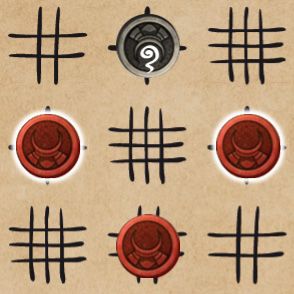
Mana HD is one of those. Created by French designer Claude Leroy, it’s a capture-your-opponent's-pieces game with a complexity somewhere between Checkers and Chess.
I digress. In short, the goal of the game is to capture your opponent’s daimyo while preventing the same.
Both players get to place their pieces within the closest two rows, but the red player always goes first and gets to rotate the board as seen fit. Whether this really provides any tactical advantage is up for debate, but there is a vague difference in the distribution of the game's three squares.
These squares form the crux of what makes the game unique. Instead of all pieces behaving the same way, as in checkers, or each uniquely, as in chess, the way your pieces move depends on two outside factors. The first is the space they rest on. Each square has anywhere from one to three hatch-marks on it. These marks equate to the number of spaces that piece can move — in a horizontal or vertical direction, never diagonally or passing over the same space twice.
While enticing your opponent into making certain moves is a mainstay of these sorts of games, the ability to actually decide which pieces are at the other player's disposal adds a layer of strategy that's novel and fun.
The presentation itself suits the elegant nature of the game, with graphics and sounds that are simple but beautifully evocative. The whole game hits those sort of notes. In a way, it’s much like the iPad itself.