Showing posts with label RPGs. Show all posts

Friday, October 11, 2013

Kickstarter Roundup 10-11-13


Where-in I pick through Kickstarter for the projects that most catch my fancy.


Hyper Light Drifter
WHAT IT IS: Gorgeous 2D Action RPG with lovingly pixelated sprite graphics and captivating artwork with a real style of its own.

WHY YOU SHOULD CARE: People's fondness for pixelated gaming is not a secret, and it seems any indie effort is as likely to sport blocky graphics as it is "HD." Those jagged edges invoke feelings of nostalgia for the games of yesteryear, and in many cases go a long way in demonstrating what kind of game you are about to play. But sometimes a game is more than that, a real statement of beauty like Sword & Sworcery was. Hyper Light Drifter is one of those games.

WHAT YOU SHOULD GET: $40. Digital versions of the game, manual, soundtrack, and artbook. You also get some other digital bonuses (like a new "sprite.") and a second key for the game, so you can actually take advantage of all those additional platforms from the stretch goals.

RELEVANT LINKS: @HeartMachineZ | www.heart-machine.com | Facebook Page

Akiba Anime Art Magazine

WHAT IT IS: A new magazine straight from Japan, featuring many talented Japanese artists and articles about Otaku culture.

WHY YOU SHOULD CARE: Japan is putting its foot into the Kickstarter ring with successful projects like Little Witch Academia and the enormously popular Mighty No. 9. By continuing to support Japanese efforts, that means we'll get to see even more of it! Besides, Akiba is a book full of lovely Japanese art, printed with a special wide gamut process that results in much brighter images than with traditional CMYK.

WHAT YOU SHOULD GET: $18 Otaku. A copy of the magazine and all of the various stretch goals that have accrued over the campaign.

RELEVANT LINKS: jhlab.jp

Game Cave Vol. 1

WHAT IT IS: A loveletter to the gaming magazines of decades gone by, rife with exciting layouts, new artwork, and a sense of humor.

WHY YOU SHOULD CARE: One of the big things I really miss about magazines is the design of them. When you view an article online, you get all the text, all the photos, and even video clips you never could have back then, but never the lovingly defined spreads, crammed to the gills with artwork, screenshots exploding from detailed backgrounds, and maybe a line of crooked text or two. It's nice to see that again.

WHAT YOU SHOULD GET: $30 Physical Book Tier. A physical copy of the magazine—I mean come on, that's the whole point, right?—plus an art print and all the digital goods.

RELEVANT LINKS:  @sketchcraft | www.sketchcraft.com | Facebook

Dawning Star: Fate of Eos
WHAT IT IS: A reboot of the fan-favorite sci-fi RPG, rebuilt from the ground up using the excellent FATE Core system.

WHY YOU SHOULD CARE: FATE is a great system, as can be attested by its modestly successful Kickstarter. So if you want to take the game to task in a far-flung future of aliens and spaceships, then Dawning Star is a good place to find it. With a flexible setting that can be tailored from pulp to space opera to interstellar intrigue with ease, and a healthy fanbase from previous editions, it's hard to go wrong.

WHAT YOU SHOULD GET: $35 EOS Defense Force. A physical copy of the game and all the digital goodies.

RELEVANT LINKS:  @DawningStarRPG | www.dawningstar.com | Facebook

Destiny Fails Us

WHAT IT IS: An “Otome” Visual Novel, a Choose Your Own Adventure-esque game featuring a female protagonist and lots of potential male suitors.

WHY YOU SHOULD CARE: While the game's use of 3D anime-style models isn't as nice as traditionally rendered art, the look serves its needs, and what you have is a fun-looking take on the date-sim. I'm especially fond of your character's cellphone that you actually check for messages throughout the game.

WHAT YOU SHOULD GET: $10 Digital Download Pack. A download copy of the game and the usual digital extras.

RELEVANT LINKS: www.destinyfailsus.com | Facebook

Wednesday, May 8, 2013

OVA: The Anime Role-Playing Game Kickstarter is Live!

The day is finally here! After much tireless effort, OVA: The Anime Role-Playing Game's Kickstarter is live! You can check on its progress to the right, or click the link below to find out more.


I want to thank all of you who supported a little anime-inspired game I made 8 years ago. I hope you find the new version was worth the wait!

Tuesday, June 12, 2012

Get your Kicks on Route 6d6


Hey, everybody. If you can’t tell by the title graphic above, here’s another update on OVA’s eventual Kickstarter.

If you follow the forums on RPG.net, you may have come across a thread where I have been discussing the final pledge tiers. For those of you who don’t — or simply missed the exchange — I’m including it here:

$15. A copy of the PDF, as well as an advance look at the game before its public release.
$30. The above, and a copy of the full-color printed book.
$50. The above, and your name printed as a patron in the book. You will also have access to a special playtest forum with the opportunity to have your voice heard and help shape the final product.
$75. The above, except your full-color book is upgraded to one of one-hundred limited box sets, each numbered and including: A copy of the printed book, your name listed as a patron, Quick-Start Player Books, a pack of character sheets, a set of trading cards, and a set of dice.
$100 The above, and a special hand-crafted OVA Dice Bag by Dragon Chow Dice Bags.
$250 The above, and a custom character sheet featuring an illustration of your character by the official OVA artist. 

Since that thread, I’ve been researching the cost of the various pledge premiums, and I've found it’s very difficult to get a box produced in any quantity less than 500, and even then it’s almost as cost-effective to get 1000. I have found an option at Superior PoD with very reasonable rates for small numbers, but the box itself looks a little flimsy. Here, take a look.

The print quality looks great, and the build seems well put together with sharp corners. It’s something I wouldn’t bat an eye at if it were simply a container to hold a bunch of goodies. But my goal was to evoke the RPGs of yesteryear, and this isn't the thick cardboard heavy-duty box you may be used to. It's more like the boxes they use for "Collector's Edition" video games.

So what do you guys think? Would you still consider a box like this a decent collectable for high-pledge tiers? Or should I revise my pledge tiers and try something else entirely?

Monday, April 23, 2012

Judging a Book by Its (New) Cover

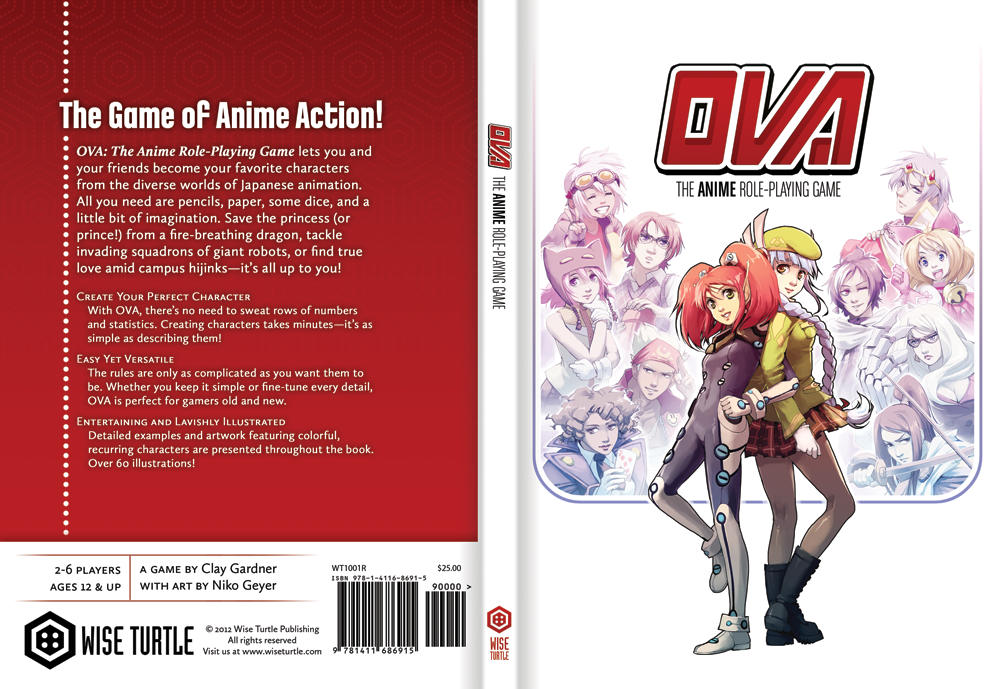
Those of you who have been waiting for a proper OVA update need wait no more. Here it is, the new cover! (Click to see it in its full-size glory.)


Even though this isn’t final, hopefully you all will find lots to love in the revised cover design. Like the rest of the book, the cover illustration is done by talented Niko Geyer, and you may even notice a new look for Wise Turtle Publishing itself!

The Kickstarter for OVA (previously mentioned here) is slated for late June/July, just in time for the game’s 7th anniversary. I’m still tinkering with the pledge premiums list, so if you have an opinion, be sure to let me hear about it! What sort of things would make you back at a higher level, and what would you pay for it? Gauging consumer interest will be very useful before jumping in the crowd-funding deep-end!

Keep checking by, as I will continue to post OVA updates leading up to the Kickstarter, including a look behind the curtains as I finalize the typesetting of the rules.

Sunday, April 8, 2012

The Box and the Hare


Outside of a fleeting flirtation with popularity in the 1980s, rpgs have always been a niche product, a collection of tomes and boxes more likely to be squirreled away in the recesses of some specialized hobby shop than displayed front-and-center in your favorite department store. Still, you’ll see the bigger rpgs, like Dungeons & Dragons, show up in the big chain booksellers, and such games are never-the-less a prominent part of our cultural identity — even if everyone isn’t aware of exactly how to play one.

But in Japan, things are a little different. rpgs may have seen the same brief rise in visibility as they did in the west, with really awesome-looking versions of D&D, Battletech, and other standbys localized for a curious audience, but nowadays Japanese rpgs are lucky to have a tiny space of three or four books in stores. Polyhedral dice are a chore to get a hold of, and besides the venerable D&D, often eschewed in favor of the stalwart six-sider. Suffice it to say, it’s a niche of a niche, to the point where rpgs have to be referred to as “Table-Talk rpgs” to differentiate them from the grossly more popular video game variety.

That’s what makes a game like Golden Sky Stories all the more remarkable. There’s no thriving “story-gaming” culture there, not a slew of diceless rpgs to draw inspiration from, no new-fangled narrative rpgs to be influenced by. It’s a microcosm of rpgs, one largely still in the same boat as our games were 10 years ago. And you'd think a game developed for a much smaller audience may have hit-and-miss production values, especially when you consider that most Japanese webpages look like Geocities came by for a visit and then never left. That’s not the case. gSS is a lovely book, with big, expressive art that brings a rural Japanese town to life. So I’ve tried to be faithful to the original design of the book as I’ve gone about rebuilding it from scratch. (No source files here, folks!)

But still, there are some things throughout the design that seems a little out of place. For instance, the book is split into four parts, seasons, and each section is introduced by art and one of these symbols. You can see the very thematic, almost sumi-e looking paint job behind the character for Spring, right? Looks great!

However, throughout the book, these stark, austere-looking rounded boxes are used for notes and callouts. In a book otherwise so warm and comfy, it seemed inappropriate to me. So I did something about it! Drawing inspiration from the seasonal characters, all of the boxes, tables, and other details have swapped their old rounded-rectangle tool attire for newer threads with rough edges and a more painted look. I think the end result is much more in character with the book, and I can only hope Ryo Kamiya, the book's author, would approve!

For your reading enjoyment, I’ve included an entire spread from the Powers section. The left-hand page features abilities all henge of a given type possess, while recto features optional ones. It’s a neat system, because in order to gain more powers, you have to take the corresponding weakness! The number in parenthesis indicates the amount of Wonder (a sort of story-telling currency) you spend to use that power.


Why the Rabbit, you ask? Well, it only seemed appropriate for today, right? Hope you all have a great Easter!

Tuesday, January 24, 2012

A Town Where Things Besides People Live

TURTLE TUESDAY

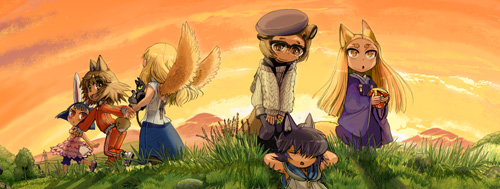
Some of you may know about a little Japanese Role-Playing Game called Yuuyake Koyake. Or maybe you know it by its English moniker, Golden Sky Stories. If you don’t, somewhere, someone referred to it as the Totoro RPG, and it’s not the worst description. The game is not about adventure in the traditional gaming sense. There’s no dragons to be bested, no empires to overturn. Instead, the game is about the little adventures, the day-to-day trials of regular people doing more or less regular things in a small, rural Japanese town. But you are not one of these people. This is a town where things besides people live. You are a henge, an animal spirit, and at your disposal is a little bit of magic. Not much, but enough to help the people of this town.

After reading that, you may already realize Golden Sky Stories is a different kind of game. There's no dice, no statistics in the traditional sense, and not even a chapter on combat. It truly is “heart-warming role-playing,” a kind of experience where you’re more likely to help a boy overcome his fear of the haunted house at the end of town than stomp goblins.

The setting and focus are not Stories’ only charm. The illustrations throughout are captivating, cute to the point of endangering bicuspids everywhere, and go a long way to setting the mood. Of course, deciphering the moonspeak of the original Japanese book is an endeavor most of us aren’t equipped to do.

Luckily for you and me, Ewen Cluney, along with the other half of Starline Publishing, Mike Stevens, translated this special game and will be bringing it to Western readers soon enough. I’ve had the opportunity to read Ewen’s top-secret (well, okay, not-so-secret) English manuscript for Golden Sky Stories, and it’s a real joy. But that shouldn't be any surprise — This isn’t Ewen’s first rodeo after all. But the text is only a part of the job. Someone has to take this text and give it a home in the pages of a book once again. That someone, as it turns out, is me!

It’s a great privilege to take part in bringing this game to life, and I look forward to sharing with you all my progress. Be sure to check by for further updates, and of course follow Ewen's blog and the Starline Publishing website for all the latest news about Golden Sky Stories.

...Oh? Why is this an entry for Turtle Tuesday? Throughout the book, you’ll meet a cast of lovable characters, including Elder Turtle. Here he is patiently listening to Riko, the tanuki henge, as she frets over some dilemma.

Friday, January 20, 2012

Far-Off Promise


A new year lay ahead, and the promise of a new set of days inspires the best intentions. The world echoes with countless commitments to work harder, be healthier, to care for each other, and to change in ways we hadn’t the year before. The sentiments are as often enough as vague as they are well-intentioned, the sort of positive thinking that we can stretch and contract to the size we can make room for.

But I want to do more than that this year. I want a game plan, as much for myself as for the accountability saying it outright provides. That’s not to say 2011 was empty of accomplishments. After all, I helped Minion Games ready no less than six games for sale in a single year -- no mean feat! And I took part in a graphical overhaul for DriveThruRPG and its sister sites that will be rolling out soon. Yet, for 2012, I want to get my things done.

So, here it is, my plan for the year. (Split up for your convenience and mine.)

My Blog 
I’ve been moving to a new computer, an iMac, for the past month or two — the lengthy travails of which I'll have to detail one or these days — but I fully intend to get this blog back on track. Besides my usual excursions of fancy, I'm launching several bi-weekly columns.

You’ve seen a taste of the first one with the Digital Gameboard. I’ll be making a point of covering all the gaming apps I come across, especially those involving euro-style board games and their kin. I stand by that the iPad is a great platform for classic board gaming fun and can use all the coverage it can get.

I’ll also be penning my foolhardy quest to play every console rpg ever. It's something that’s become ever more difficult as my list of unplayed and unfinished games grows longer. But maybe by adding you all to my party, this quest may become less of a foolhardy one.

And for those of you wondering, yes Minion Monday will eventually finish out its run. I’m waiting on my own physical copies of the games so I can better show off the components. It’s just taking a little longer than expected.

My Games
While there’s a certain anime-inspired elephant in the room, I have up my sleeves a plethora of games I've tinkered on in perpetuity, and I’d really like to finally get some of them out the metaphorical door and into the light. While finishing, much less releasing, all of them in this revolution of the sun is a unlikely accomplishment, I do want progress, and I want to share that progress with you. Here's a highlight reel of what to expect.

OVA — Yes, the oft-promised return of Wise Turtle's flagship product is still very much in the works, and I’ve made a commitment to its release in the early half of 2012. Long-time fans may have dim memories of several supplements that I hope to talk more about and bring closer to release. You can see a sample of artwork for a sci-fi-themed supplement on the left of the header, done by feguimel.

Legendary! — While I love all my work for Minion Games, and all its games are special to me, they’re still not mine in any true sense of the word. Legendary! is a fantasy dungeon-crawl of a board game inspired by fond childhood memories of Dungeon, but with enough twists to the formula that I believe in its ability to give something new to a crowded and often trite set of games. It’s infused with lore from a lifetime of love for console rpgs, and the very talented Honoel Ibardolaza certainly brings it to life. That trio of numbskulls in the header is his handiwork.

Last Legend — Before OVA, I was a devoted follower (and sometimes contributor) to the Returner Final Fantasy RPG, an attempt to capture the spirit of the eponymous video games in pen and paper form. Eventually I left that community over a difference of opinion...whereas most were concerned with copying the actual game mechanics and number crunching of the video games, I felt the rules would be better served trying to approximate the feel of rpg battles and leave the math for the CPUs that spawned it. Last Legend is my on again, off again take on the subject. You can see some art from it in the header, this time the inks in the background that are once again provided by Honoel.

iOS — Tied in with all these is a general interest in the iOS platform. Now that I have an iMac (more about that in a future post), exploring the world of iPads and iPhones is a real possibility. While the likelihood of me gaining enough prowess with programming to create a game of any decent measure is not good, having access to the tools does open other interesting opportunities. OVA-dedicated apps to aid with dice-rolling, character creation, and even easy rules reference would be a great resource to provide players, and iOS versions of the various Minion Games would be cool indeed.

My work for others
While I said I wanted to make 2012 a year for my projects, there is at least one outside job I'm really excited about. If you follow Ewen Cluney's blog, you may already know what I mean. If not...well, be sure to check by Tuesday for my own official announcement!

Thursday, August 25, 2011

Ain’t That a Kick in the Head?


With the obligatory channeling of Dean Martin behind me, I want to talk to y’all about a potential Kickstarter campaign for OVA. For those of you unfamiliar with the concept, Kickstarter allows creators to raise money to fund their projects. Fans pledge varied amounts of money, with higher pledges netting them increasing rewards, benefits, and goodies. If the total amount of pledges reaches a number set by the creator, the project is funded. If it falls short, no one pays a dime. It’s a low-risk way to support projects you care about without worrying if it will actually happen or not.

What I’m curious about is what sort of incentives will actually interest you enough to pledge. I’ve included a list below of ideas I had as additional bonuses to the basic “preorder the book” option. Which fill you with excitement and a prurient desire to part yourself from your money? Which instill only a tepid response?

A ranked list isn't required, but whatever time you can spend detailing your interest would be greatly appreciated. I want to gauge which of these are wanted most, and how much you would be willing to pledge to attain a given reward.

Under each item I have included a description and additional points of inquiry for discussion.

Early Access to the PDF
Self explanatory. How much earlier than its release date would you expect to see it? What would the least amount of time be to feel you’re getting something?

Signed Copy of the Book
Would personalized inscriptions increase your interest in this?

Trading Cards
Cards featuring art from the game. May also include quick reference for character stats or an extremely simple mini-game.

Limited Edition Box
A box including the book, quick-start player books, character sheets, and a set of dice.

Art Prints
Frame-able prints of artwork from the game. What size would you want to see most? Or would you like to see it poster-sized?

Wall Scroll
Artwork from the game printed on a wall scroll just like the ones you see for commercial anime.

Character Figure
A painted mini sculpture of one of the OVA characters, similar to ones common for most anime. Which character would you most want to see given this treatment?

Personalized Character Pin-Up
An illustration of your OVA character as part of a custom-designed character sheet.

Lifetime Wise Turtle Subscription
Free access to all future Wise Turtle products. Includes PDF and print versions. FOREVAH.

So? What do you think?

Monday, August 22, 2011

Come as QR

You’ve probably seen them somewhere, bizarre blocks of pixels that appear something between Conway’s Life and a Rorschach ink blot. These QR Codes actually encapsulate small bits of data encoded into their zebraic patterns of white and black. A two-dimensional barcode. While originally created in Japan — isn't everything these days? — to manage part numbers in factories, QR codes are now used for all kinds of things. The one here contains a URL link to this blog. Not strictly the most useful of applications since you are presumably already here...

The Japanese have been scanning and using these things with their futuristic cell phones for years, but then Japanese cell phones have always been a little ahead of the curve. I still remember nights spent watching Serial Experiments Lain and thinking how out-of-this-world text-messaging seemed. Good ol’ Japan.

But now that the smart phone has become nearly as ubiquitous as the cellphone itself, the potential practicality of QR codes is hard to ignore. Print advertisements are taking advantage of its ability to link to websites and products, and the recently released Little Big Planet 2 can contain data for entire player-made levels in that pixel-parqueted patch.

But the QR code could hold great potential for tabletop gaming, too. Sure, there’s the obvious uses. Codes could link to the publisher website, to up-to-date errata documents, or even to printable character sheets. But take it a step further. Table-side apps to handle character sheets and dice rolls have become regular guests at gaming groups. But what if one of these apps could not only hold an entire character sheet, but could scan another player’s? A quick wave of the iPhone and a Game Master could have up-to-date data on the entire party. While browsing the latest Monster Manual, when that Game Master sees a beastie they like, zip, a quick scan and all the essential stats are imported. Players could perform complicate dice rolls and calculations by scanning a specific location on the character sheet.

As these things tend to be, it’d be an obscure novelty at first. But in the future, we could really see true integrative gaming, with the old and the new shaking barcoded hands. Those QR codes kind of look like cool monsters anyway, right?

If you’re looking for a QR reader on your iPhone or iPod Touch, I recommend I-nigma. It’s the software that’s been featured on countless Japanese cellphones for years, and it shows they've had the practice. Of five apps I installed, it had the quickest response when presented a QR code, as well as a great set of sharing features. Tweet it, Facebook it, even recreate any code you've scanned for others to scan right off your device. If you prefer a Swiss army knife approach, RedLaser is a decent scanner of all kinds of barcodes and automatically compares prices online. Both are free.

Tuesday, August 9, 2011

OVA Chapter Preview

It’s been quite a spell since I've had much in the way of news for OVA. Progress has been slow, but I'm happy to say things are finally moving along at a steady clip. We’ll see a 2011 release yet!

But I don’t want you to have to take my word for it. Just click here for a complete chapter from OVA Revised Edition.

Hopefully it’ll whet your appetite for what’s to come on this Wise Turtle Tuesday!

Tuesday, March 22, 2011

Turtle Tuesday and Other Strangeness

TURTLE TUESDAY
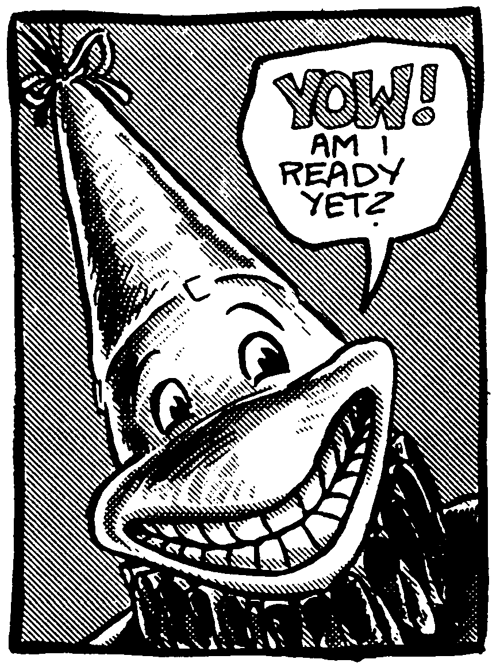
As a child of the 80s, I was a fan of Teenage Mutant Ninja Turtles. This statement wouldn’t be a terribly unique one if not for how much of an understatement it was. I watched all the cartoon episodes, I had all the action figures [1] including the turtle van, I played all the video games and the board game. I even had Ninja Turtle stuffed animals. I noted the irony of a furry Michelangelo, but that didn’t stop it from being AWESOME.

But for every “Turtle Power!” I chanted then, part of me shakes my head now. That’s not to say the cartoon isn’t still a lot of fun in its own goofy, toy-advertising way [2] — nostalgia makes us all fools with rosy spectacles — but it’s not why I’m still a big Turtles fan. At least not all of why.

That’s because before there was a cartoon, there was a comic. It was a darker, more serious tale, featuring four ninja turtles yes, but willing to deviate from pure mutagen antics the concept begot for tackling, dare I say, human issues. For comparison, the first movie is a rough retelling of one of the beginning comic arcs.

I was just getting to be a teenager myself, able to crave more than pizza monsters, when my brother introduced me to a four volume set of the original Eastman and Laird stories [3] Already addicted to everything Turtles as it was, I was captivated by it. I read them thoroughly, multiple times even, before I started collecting individual issues on my own.

And then there was Teenage Mutant Ninja Turtles and Other Strangeness. It was a Palladium game, first published years before the cartoon/action figure boom, and as such was steeped in the world of Eastman and Laird, not Playmates Toys.

It was notable for several things. Not only was it a licensed game, it was a licensed game with the involvement of the creators. Sure, panels from the comics were littered throughout, but there was plenty of new art, too. It made it feel more special, more real. It was like an actual extension of the story, and not just a cash-in license.

The rules themselves are cluttered, broken, and incomprehensible in the wonderful way all Palladium games are. It’s playable, sure, but it’s way more complicated and inconsistent than it needs to be. It’s harder to forgive newer releases — cough Robotech: Shadow Chronicles cough — but back in the 80s, most RPGs were like this. And where the randomized character creation could really prove frustrating for a game like, say, Heroes Unlimited, it really felt right for TMNT. Mutation was happenstance, and discovering the crazy animal you were going to be was part of the fun. The game’s BIO-E point system did allow you some customization, letting you place your mutant between "sentient animal" and "full-blown anthropomorph." It gave control to an otherwise chaotic character creation, and it was great.

But then came the cartoon. To gamers, the Turtles were no longer this cool indie comic but a silly kids show. Sales of the RPG plummeted and Palladium let the license lapse. It was survived by the mutant animal spinoff After the Bomb for some years, but support for it would wane too, as is the way with many RPGs. I can’t say I was the biggest fan of the Palladium rules, but I was of this game. But to blame the cartoon for much is silly and unfair. After all, without the cartoon, I may never have been a fan of this RPG, or of turtles wielding ninja weapons at all.

Cowabunga.


[1] Well, not all. Do you remember how many there were? Do I even need to say Space Cadet Raph? Really, do I?
[2] Perhaps you'd prefer Crazy Clownin' Mike?
[3] Ironically, the comic actually gives Crazy Clownin' Mike precedent.

Friday, March 4, 2011

GM's Day


Today is GM’s Day. I'm always fond of this holiday — for much of the same reasons I'm fond of all things RPG, but the fact I designed the logo doesn’t hurt. It’s among the favorites I've ever done.

It’s also — entirely coincidentally — the third anniversary of Gary Gygax’s passing from this realm. I don’t have as many or as storied memories of his work as some of my role-playing fellows, but I do still remember a certain Dungeon Master’s Guide. Frayed about the edges, its interior cluttered and haphazard for sure, but that book was just filled with so much wonder. Its delightfully diffuse vernacular was both esoteric and amiable in a way that can only be called Gygaxian. I miss books like that.

Wednesday, February 9, 2011

The Winter of the Cherished Storyteller


I remember school book fairs with fondness, with the warm but distant feelings many things from childhood are bestowed. It’s a nostalgic sort of praise that is more than many actual memories should warrant, and so it was with these scholastic events. There were books, sure, but of the childish kind that schools expected their students to read and not the daring tales of high adventure that I had grown so fond of. If there were aliens, they were silly and green. If there were wizards, they had pointy hats and magic wands. But there were plenty of useless knickknacks to spend my book fair allowance on — like little sports cars books from which I could memorize top speeds and accelerations — so all was well. Well, except when those managing the fair's sales insisted on stamping my books. The practice of permanently inking blue bears on my precious purchases never sat well with me.

But when I reached middle school, the book fair grew up a little with me. There were honest-to-goodness novels here, and that was a treat. I eagerly scanned the shelves, scouring for a world to explore. And then I came across it. Redwall by Brian Jacques.

At first blush, it would seem a step back, a story peopled not with fantasy heroes but talking mice and other rodentia. It was more of the trite kid-stories I had long sidestepped.

But it wasn’t. The book had the weight of a novel, and small black-and-white illustrations of swords and daring-do tantalized the interior with the promise of adventure. And the cover itself! Not a Disney-esque illustration, but blackletters and paneled pictures conveying the magic of an old medieval manuscript, all surrounded by a vivid teal. It’s sequel, Mossflower, was there too, and soon they both were mine.

I started reading right away, cramming its chapters of unlikely mouse heroes and legendary swords between classes, pondering its rhyming riddles with wonder. The prose was flavorful but succinct, conveying sumptuous feasts and ancient red walls with clarity and musicality. I'd sing with the heroic ballads, laugh at garrulous hares and quarrelsome shrews, and cry when the good guys fell to the wicked. I’d go on to read a lot of tales from Redwall.

Just as I was discovering Redwall on paper, I had just gotten my first Internet account and with it access to the World Wide Web. It was still, as I was, a young place, brimming with new ideas and really horrendous websites. There were so many places to go. And go I went, seeking even more of the Redwall world I had come to love.

There was an official webpage, which held my interest for a time, but what really grabbed my attention were the many unofficial Redwall clubs. There was at least several score of them, all ostensibly unique in their own way but ultimately the same at their core. You submitted a character to join and in turn were given missions to accept. These missions were really story prompts, and you completed them by doing just that, writing a story. Completing missions earned you medals and the prestige of promotion through a ladder of ranks.

It was a wonderfully simple idea, a concept that embraced storytelling for its own sake while giving the kind of instant gratification kids desire. Of course, most of these clubs were run by kids themselves, and of the many I joined, most petered out quite quickly. But in that time I was a ne'er-do-well in a pirate ship's crew, an unruly dibbun against bedtime, a vermin of a villainous entourage second-guessing his ways, and a loyal defender of Castle Alelea. I even started my own club, Redwall 3000, its calling card a sci-fi spin on Jacques' world. This was the awesomest idea ever at the time, but I can only laugh now at how dreadful it would be to Brian Jacques himself.

Of these clubs, Castle Alelea was one of the oldest and quite possibly the best. The site existed as a real locale, teeming with rooms to explore as you followed one underlined link to the next. At each turn your eyes were greeted with hand-drawn art and your ears treated with strains of music. It was a pretty special place, its magic something that many clubs, including my own, would try to capture.

That site was the handiwork of Kelly Hamilton. She would eventually become one of the first friends I made through a world connected by 1s and 0s, and many years later would help shape the look of OVA.

But before there was even the first keystrokes of OVA, Redwall would inspire my first serious attempt at writing an RPG. It was a bit of a mess, cobbling my favorite elements from Champions, Fuzion, and Rolemaster, but it was never-the-less complete. And even if it were horrifically inappropriate for Redwall, I learned a lot from making that game. What worked, what very much didn't, and how to let go of hard-wrought rules for the bettering of the game. Discarding the original Rolemaster-esque critical hit tables for a single simpler, more open one was tough. But I knew I did right, and while the game was still a train wreck, it was a wee bit less of one.

I would keep reading Redwall, but as the years went on, my blind wonder waned. I became disenchanted with Redwall's quaint halls and its minute inhabitants. Each would-be conquest of the red-stoned abbey began to stretch credulity, the resolutely black-and-white, good versus evil stories that once attracted me started to feel shallow, and every new book felt more the same than it did different. Eventually I stopped reading them altogether. It’s too bad since many of the following books explored times before Redwall, and I always felt the other Redwall-less books like Mossflower and Martin the Warrior were Jacques at his best. But even without his work over the last decade, I'll never forget all the ways his stories touched me, how his prose helped shape my own writing voice, and the way loving his world would form my earliest memories of making websites, RPGs, and friends.

Thank you for everything, Mr. Jacques. Thanks for believing a clumsy mouse in flip-flops could one day wield a sword and be a hero.

Friday, January 21, 2011

Thinking Inside the Box


The role-playing game has changed a lot in the past decades. It’s had its waxes and wanes in popularity, its trends in game design, and more than a few really funny looking dice along the way. But if you were to look at the industry from the outside — as someone who barely knew what an RPG was, much less concerned with the evolution of rules and design — one of the single most obvious changes is the abandonment of the boxed game.

That’s not to say there aren’t boxed games anymore. Wizards of the Coast’s new homage to the iconic Red Box can attest to that much. Nor am I saying that heavy hardbound tomes weren’t around ages ago, what with Gary Gygax’s approach for the original Advanced Dungeons & Dragons. But at the same time, game makers’ expectation of who their gamers are has drastically changed. A game's largest body of fans are the same grognards that have been buying RPGs for decades, a group that has little need for yet another set of dice.

It’s an expectation that makes sense. It doesn’t hurt that RPG fans host a disproportionately large gathering of bibliophiles that appreciate the beauty in a well-designed book. Abandoning the box allows a greater attention to creating such things and trims the fat out of a gaming collection.

Yet there just is something downright magical about a box. It’s more than a vessel for carrying contents; it’s a promise of the unknown. Beneath its cardboard exterior lay all the materials you need to embark on countless adventures — and probably a few things you don’t. But even if the back features a itemized list of every last punch-out token that hides inside, there’s still some glorious sense of surprise when you lift the lid off for the first time.

Boxes are inclusive. Modern rulebooks tend to be the domain of the Game Master, or a requisite purchase for all Players to invest in and make use of to create the awesomest hero. But when you whip out the box, there’s everything everyone needs. Hand over the introductory rulebook, pass out the character sheets! It makes trying a new RPG as easy as popping open Monopoly.

I think that feeling of open invitation is a grand factor in why board games are doing so well now. Even if there’s a high price sticker stuck to the front, there’s comfort in the idea you can just buy just that one thing and be ready to roll right out of the box. It doesn’t make the assumption you’ve played an RPG before, or that you have fellow geeks to explain it to you. It’s a gate all by itself, with a view of the world beyond and a set of keys hung neatly to its side, waiting for you and whoever else you want to bring along to unlock it.

And I think that’s a mistake much of the RPG industry is making. Despite being an entirely social activity, RPGs have become more and more a private place. The gate has been replaced with iron doors and the activities beyond like a clandestine secret society, their charter an endless collection of rules, addendum, and errata. There are players out there who don’t even know they love RPGs — the expansive realm of freeform message board role-plays are proof enough of that. I think our little niche of the world could be a slightly bigger one if we didn’t always wave around 10 pound books and instead proffered a little promise, sealed away in a box.