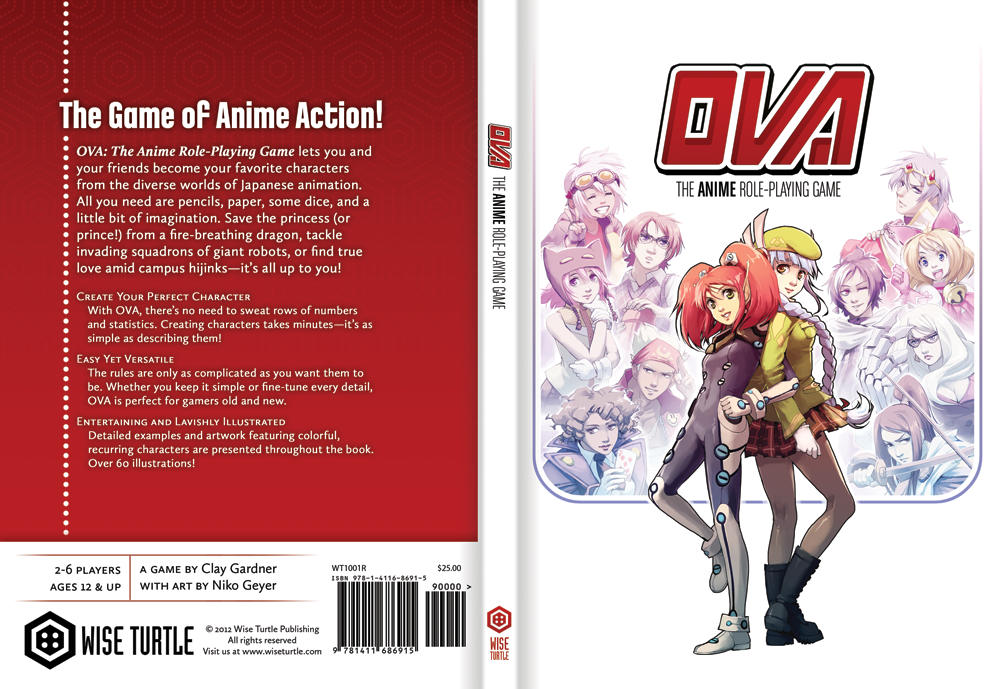
Those of you who have been waiting for a proper OVA update need wait no more. Here it is, the new cover! (Click to see it in its full-size glory.)
Even though this isn’t final, hopefully you all will find lots to love in the revised cover design. Like the rest of the book, the cover illustration is done by talented Niko Geyer, and you may even notice a new look for Wise Turtle Publishing itself!
The Kickstarter for OVA (previously mentioned here) is slated for late June/July, just in time for the game’s 7th anniversary. I’m still tinkering with the pledge premiums list, so if you have an opinion, be sure to let me hear about it! What sort of things would make you back at a higher level, and what would you pay for it? Gauging consumer interest will be very useful before jumping in the crowd-funding deep-end!
Keep checking by, as I will continue to post OVA updates leading up to the Kickstarter, including a look behind the curtains as I finalize the typesetting of the rules.
Monday, April 23, 2012
Sunday, April 8, 2012
The Box and the Hare
Outside of a fleeting flirtation with popularity in the 1980s, rpgs have always been a niche product, a collection of tomes and boxes more likely to be squirreled away in the recesses of some specialized hobby shop than displayed front-and-center in your favorite department store. Still, you’ll see the bigger rpgs, like Dungeons & Dragons, show up in the big chain booksellers, and such games are never-the-less a prominent part of our cultural identity — even if everyone isn’t aware of exactly how to play one.
But in Japan, things are a little different. rpgs may have seen the same brief rise in visibility as they did in the west, with really awesome-looking versions of D&D, Battletech, and other standbys localized for a curious audience, but nowadays Japanese rpgs are lucky to have a tiny space of three or four books in stores. Polyhedral dice are a chore to get a hold of, and besides the venerable D&D, often eschewed in favor of the stalwart six-sider. Suffice it to say, it’s a niche of a niche, to the point where rpgs have to be referred to as “Table-Talk rpgs” to differentiate them from the grossly more popular video game variety.
That’s what makes a game like Golden Sky Stories all the more remarkable. There’s no thriving “story-gaming” culture there, not a slew of diceless rpgs to draw inspiration from, no new-fangled narrative rpgs to be influenced by. It’s a microcosm of rpgs, one largely still in the same boat as our games were 10 years ago. And you'd think a game developed for a much smaller audience may have hit-and-miss production values, especially when you consider that most Japanese webpages look like Geocities came by for a visit and then never left. That’s not the case. gSS is a lovely book, with big, expressive art that brings a rural Japanese town to life. So I’ve tried to be faithful to the original design of the book as I’ve gone about rebuilding it from scratch. (No source files here, folks!)
However, throughout the book, these stark, austere-looking rounded boxes are used for notes and callouts. In a book otherwise so warm and comfy, it seemed inappropriate to me. So I did something about it! Drawing inspiration from the seasonal characters, all of the boxes, tables, and other details have swapped their old rounded-rectangle tool attire for newer threads with rough edges and a more painted look. I think the end result is much more in character with the book, and I can only hope Ryo Kamiya, the book's author, would approve!
For your reading enjoyment, I’ve included an entire spread from the Powers section. The left-hand page features abilities all henge of a given type possess, while recto features optional ones. It’s a neat system, because in order to gain more powers, you have to take the corresponding weakness! The number in parenthesis indicates the amount of Wonder (a sort of story-telling currency) you spend to use that power.
Why the Rabbit, you ask? Well, it only seemed appropriate for today, right? Hope you all have a great Easter!
Sunday, April 1, 2012
Nyan Cat: Rainbow Race
I’m ecstatic to reveal the box art for Minion Games’ next title. As a subject near and dear to my heart, I’m so excited we were able to procure the license bouncing off the success of the now sold-out Manhattan Project.
Nyan Cat: Rainbow Race is a “real-time” card game for 2-4 players based on the popular internet meme. Instead of taking turns, players can draw, discard, and play cards at any time. The deck consists of 6 colors: red, orange, yellow, green, blue, and purple, which are shuffled and evenly divided among the players to become individual draw decks. When you draw a card, you may either place it in your hand or play it to your play area on the table. Cards played to the table are organized by color, and the goal is to create the biggest stack of a single color. Players may not have multiple stacks of the same color on the table in front of them at any point in the game. When players feels like their stack is big enough, they can take the whole stack and put it in their scoring pile. If a stack of that color already exists in the scoring pile, the new pile must be at least one larger, and the old pile is discarded.
There is also the Nyan Cat card. This special rare card can be played on top of anyone’s color stack, and that stack immediately goes to the Nyan Cat player’s scoring pile. Managing how big to make your color stacks — to maximize score value but hopefully not attract other players' desirous eyes! — is the core of the game.
Once all cards have been played or discarded, scoring is handled in traditional Knizian manner: The player with the most cards in their smallest color stack is the winner!
Once again, I can’t express how enthusiastic I am about this game. I designed it from the ground up with Nyan Cat in mind and to be accessible to younger players. I only hope the gaming public will find I’ve succeeded! Keep checking by in the coming months for updates as Nyan Cat: Rainbow Race goes through production!
Nyan Cat: Rainbow Race is a “real-time” card game for 2-4 players based on the popular internet meme. Instead of taking turns, players can draw, discard, and play cards at any time. The deck consists of 6 colors: red, orange, yellow, green, blue, and purple, which are shuffled and evenly divided among the players to become individual draw decks. When you draw a card, you may either place it in your hand or play it to your play area on the table. Cards played to the table are organized by color, and the goal is to create the biggest stack of a single color. Players may not have multiple stacks of the same color on the table in front of them at any point in the game. When players feels like their stack is big enough, they can take the whole stack and put it in their scoring pile. If a stack of that color already exists in the scoring pile, the new pile must be at least one larger, and the old pile is discarded.
There is also the Nyan Cat card. This special rare card can be played on top of anyone’s color stack, and that stack immediately goes to the Nyan Cat player’s scoring pile. Managing how big to make your color stacks — to maximize score value but hopefully not attract other players' desirous eyes! — is the core of the game.
Once all cards have been played or discarded, scoring is handled in traditional Knizian manner: The player with the most cards in their smallest color stack is the winner!
Once again, I can’t express how enthusiastic I am about this game. I designed it from the ground up with Nyan Cat in mind and to be accessible to younger players. I only hope the gaming public will find I’ve succeeded! Keep checking by in the coming months for updates as Nyan Cat: Rainbow Race goes through production!
Monday, March 26, 2012
Ode to a Grecian Game
MINION MONDAY
Greek mythology: A tried and true lore of ancient heroes, incomparable threats, and completely baffling logic that is the mainstay of our educational culture. But even if Zeus was found wanting of aspirin and birthed goddesses from his forehead in the driest way a textbook knew how, there’s still an ancient power to these myths, a strength derived from thousands of storytellers, each imparting a bit of their own life, and a bit of their own imperfections, as the tales found their way to the modern day. This is truer of nothing than the Greek's epic poetry, and no one has captured the rhythm and lifeblood of an ancient people as Robert Fagles.
I still remember his translation of the Iliad, an old hardback tome, perhaps then new, resting on the coffee table. The cover black, the top of the leaves painted red, if not for all those sturdy souls sent to House of Death, then for a really swell looking book. It was my mother’s, and where Mythology 101 might not have had any love for the Greek gods and goddesses of yore, she imparted a fascination with swift-footed Achilles and his unquellable rage, Lord of Men Agamemnon, Hector, Paris, Helen, and all the tragedies of the war on Troy.
Rage— Goddess, sing of the rage of Perseus’ son Achilles! Lines like this reverberated with me, and it inspired a adoration not just for Greek myth, but of all old epic poetry, from the alliterative Beowolf to the often very redundant Gilgamesh.
But for all its enduring imagery and epic tales, the world of Greek myth feels seldom acknowledged in the world of gaming. Sure, one could dig up that GURPS sourcebook or an aging board game of some nature, but for a mythology ripe with all the tropes we associate with the omnipresent medieval fantasy, it’s a missed opportunity for games both new and familiar.
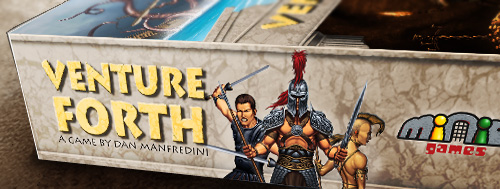
So when Minion Games head honcho James Mathe first showed me Venture Forth, I was pretty enthusiastic. The bones were there for a game rife with the kind of magic I felt reading the epics, and maybe even such irreverent romps as the 1980s Clash of the Titans. But the prototype itself was bare of theme, a blank slate that could as easily been Tolkien as Homer. Time to crack those knuckles!
As I said, the game symbols used in the prototype given to me were all very generic affairs, with medieval chevron shields and golden trophies. I replaced them with Greek equivalents, sturdy round shields, gleaming gladii, and ancient urns. With proper icons in place, it seemed only fitting to use the most iconic of Greek contributions, the architecture of the period, as my inspiration for the card borders.
After completing the frames, I started to place the work by James Denton into my card sheets. The art was big and bold, maybe even a little over-the-top at times, which felt perfect for the sort of Greek high-adventure we were talking about. But inside my frames they felt encroached upon, constrained. One does not contain such gods of men and creatures of myth! It was then I decided to make the artwork “pop over” the edges. It made the monsters more daunting, the heroes more adventuresome, and all in all just seemed more exciting. Unfortunately, most of the artwork was provided without layers, so this effect took quite a bit of love and care. Zooming in at 600% helps as you're carefully trimming the art away from its original background. The end “coming out at you” result was worth the time. The tiny cards feel that much bigger for it.
For the card backs, I decided to make it stand out from the front art by using traditional “black-figure” imagery from Grecian urns. I drew it myself based on a particular urn featuring god of war Ares and surrounded it with the ornamental details that seemed fitting.
Venture Forth itself is a great game that takes the things you love about an adventure board game, leaves out the trite, trying stuff you don’t, and wraps it in a golden fleece of Euro-gaming standbys that together feels fresh and new. Helping your party of adventurers meet their fated ambitions instead of just killing monsters leads to a very Greek feeling tale, and the amount of depth provided by cultivating paths, hiring new heroes, and overcoming obstacles just makes for a very complete and satisfying package.
If that sounds like the kind of game for you, and you lack the ability to pop it fully-formed from your forehead, make Hermes-like haste to MinionGames.com and score yourself a copy. Ordering directly from us means more of your dollar goes to support the people who made the game possible! That, and you'll get this special Treasure Card, not available anywhere else!
Greek mythology: A tried and true lore of ancient heroes, incomparable threats, and completely baffling logic that is the mainstay of our educational culture. But even if Zeus was found wanting of aspirin and birthed goddesses from his forehead in the driest way a textbook knew how, there’s still an ancient power to these myths, a strength derived from thousands of storytellers, each imparting a bit of their own life, and a bit of their own imperfections, as the tales found their way to the modern day. This is truer of nothing than the Greek's epic poetry, and no one has captured the rhythm and lifeblood of an ancient people as Robert Fagles.
I still remember his translation of the Iliad, an old hardback tome, perhaps then new, resting on the coffee table. The cover black, the top of the leaves painted red, if not for all those sturdy souls sent to House of Death, then for a really swell looking book. It was my mother’s, and where Mythology 101 might not have had any love for the Greek gods and goddesses of yore, she imparted a fascination with swift-footed Achilles and his unquellable rage, Lord of Men Agamemnon, Hector, Paris, Helen, and all the tragedies of the war on Troy.
Rage— Goddess, sing of the rage of Perseus’ son Achilles! Lines like this reverberated with me, and it inspired a adoration not just for Greek myth, but of all old epic poetry, from the alliterative Beowolf to the often very redundant Gilgamesh.
But for all its enduring imagery and epic tales, the world of Greek myth feels seldom acknowledged in the world of gaming. Sure, one could dig up that GURPS sourcebook or an aging board game of some nature, but for a mythology ripe with all the tropes we associate with the omnipresent medieval fantasy, it’s a missed opportunity for games both new and familiar.
So when Minion Games head honcho James Mathe first showed me Venture Forth, I was pretty enthusiastic. The bones were there for a game rife with the kind of magic I felt reading the epics, and maybe even such irreverent romps as the 1980s Clash of the Titans. But the prototype itself was bare of theme, a blank slate that could as easily been Tolkien as Homer. Time to crack those knuckles!
As I said, the game symbols used in the prototype given to me were all very generic affairs, with medieval chevron shields and golden trophies. I replaced them with Greek equivalents, sturdy round shields, gleaming gladii, and ancient urns. With proper icons in place, it seemed only fitting to use the most iconic of Greek contributions, the architecture of the period, as my inspiration for the card borders.
For the card backs, I decided to make it stand out from the front art by using traditional “black-figure” imagery from Grecian urns. I drew it myself based on a particular urn featuring god of war Ares and surrounded it with the ornamental details that seemed fitting.
If that sounds like the kind of game for you, and you lack the ability to pop it fully-formed from your forehead, make Hermes-like haste to MinionGames.com and score yourself a copy. Ordering directly from us means more of your dollar goes to support the people who made the game possible! That, and you'll get this special Treasure Card, not available anywhere else!
Wednesday, March 21, 2012
A Game of the Game of the Generals
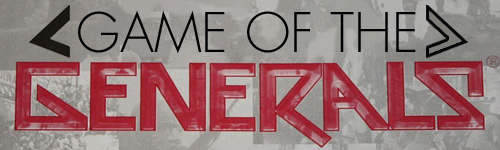
I was speaking to a friend, the very talented Honoel, about board games when he brought up Game of the Generals. It was one he remembered fondly from his childhood, and the game was noteworthy for being native to his home in the Philippines. Both players had an army of plastic pieces, each unit labeled with a different rank. Each rank could capture any piece of those ranked under it, except the lowest rank, which could only capture the highest ranked piece in the game. This in itself could be a fun diversion, but the twist lay in that these ranks were only labeled on one side, keeping your troops a complete mystery to your opponent. The goal: protect your flag and capture the enemy’s! The game itself is over 40 years old, but I still managed to find a picture of it.
Okay, yes, as it turns out Game of the Generals is a thinly veiled copy of the classic Stratego. It’s not devoid of differences: The lakes that serve as a choke point are absent, the spy occupies the top rank instead of the bottom, and there are no mines or units to defuse them. The game also explicitly calls for an arbiter to decide conflicts instead of revealing both pieces after a capturing attempt. While the idea of sitting through a game doing nothing but comparing pieces for your friends sounds like a great way to spend an evening, I’d be surprised how often this actually happened. The most interesting change, though, is that your flag can move. Instead of being stuck in the space it started, forcing you to protect it and devise a red herring or two, it can navigate the board like any other unit. Moreover, if you manage to reach the farthest row with your flag, as one would promote a pawn in chess, you win the game. It’s not enough to regard Generals as much more than the Stratego-clone it is, yet I find it an interesting variation just the same.
While The Army Game's exact origin is unclear, copies from the 1950s prove that it’s at least a rough contemporary of the original Netherlands Stratego in 1949. (For the record, Stratego didn't reach America until 1961, and Game of the Generals was first released in 1970.)
So who copied who? With The Army Game’s history being so hopelessly obscure, it’s hard to say for sure. That is, if it weren’t for the fact another game predated them both. L’attaque was first published in France in 1910 with rules largely identical to Stratego. But what’s really interesting about L’attaque is that the creator is Mademoiselle Hermance Edan.
Yes, you saw that right. A lady. Creating a war game. In the early 1900s. When you consider how guy-centric the war-game and RPG industries were in the 70s and 80s, it’s a fun footnote that such an early example was designed by the fairer sex. Unfortunately, I could find little about her beyond the same handful of sentences regarding her patent filing in 1908, quoted pretty much everywhere that discusses the origin of L’attaque and Stratego.
So you’d think that would settle it. L’attaque and by extension Stratego came first, with The Army Game being a loose variant.
Unfortunately, like with The Army Game, information on Jungle’s exact origins and date of inception are not to be found. Due to its fable-y charm with its animal pieces, many people assume it’s an ancient game. However, an exhaustive piece of research on Chinese games, penned by Professor Stewart Culin in the late 1890s, has no reference to Jungle whatsoever. So either the man left a rather glaring hole in his research, or Jungle isn’t nearly as old as it’s often given credit for. If we take for granted Culin didn’t pass out drunk on the fated Chinese Family Game Night where he would have played Jungle, this gives us a period from 1890 to 1910 for Jungle to be created and become popular enough to influence a French game-creator.
While rooting about the web did reveal references here and there to Jungle appearing in 1900, none of these cite any source for such a claim. The earliest concrete date I can find is the 1974 Four Generation's “Games of the World” series of board games. The text there describes Jungle as an “ancient game,” but it’s a statement again with skeptical veracity. While a game would likely exist in China long before showing up around the world, this lack of firm history damages any theory that it formed the basis of Stratego, or possibly even The Army Game.
The real answer of the origins of Stratego may be one lost to time. I would love to find hard evidence of a copy of Jungle existing in the early 1900s, but the scope of such research is outside of my ability. For now, I think due credit should be given to Edan and her little game of wars, L’attaque. There is no evidence I can find to support Jungle’s identity as an ancient Chinese game instead of a mid-twentieth-century knockoff, and I think crediting it as many Stratego histories do is a disservice to this female gaming pioneer.
Friday, March 16, 2012
Monster Hearts
Hey everyone! I’ve been a little under the weather, and as an unfortunate consequence this little corner of the web has been left more unattended than I’d like. But expect that to change as we return to regularly scheduled programming!
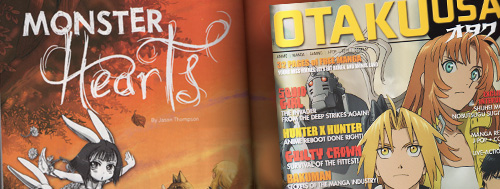
While I won’t have an honest update for my work on Golden Sky Stories till next week, I did want to share that Otaku USA has an incredible 4-page piece on the book in its April issue. The issue changes over March 20th, so run (don't walk) to your closest newsstand and pick up a copy. Besides netting yourself a fine overview of GSS, including my translated version of the Hitotsuna Town map, you’ll also be supporting one of the last anime magazines still in production. If that’s not win-win, I’ll eat the magic leaf under my hat.
Tuesday, January 24, 2012
A Town Where Things Besides People Live
TURTLE TUESDAY
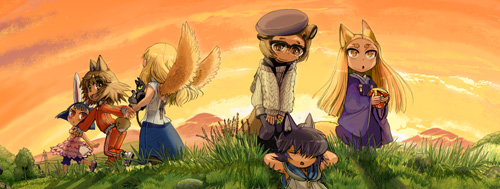
Some of you may know about a little Japanese Role-Playing Game called Yuuyake Koyake. Or maybe you know it by its English moniker, Golden Sky Stories. If you don’t, somewhere, someone referred to it as the Totoro RPG, and it’s not the worst description. The game is not about adventure in the traditional gaming sense. There’s no dragons to be bested, no empires to overturn. Instead, the game is about the little adventures, the day-to-day trials of regular people doing more or less regular things in a small, rural Japanese town. But you are not one of these people. This is a town where things besides people live. You are a henge, an animal spirit, and at your disposal is a little bit of magic. Not much, but enough to help the people of this town.
After reading that, you may already realize Golden Sky Stories is a different kind of game. There's no dice, no statistics in the traditional sense, and not even a chapter on combat. It truly is “heart-warming role-playing,” a kind of experience where you’re more likely to help a boy overcome his fear of the haunted house at the end of town than stomp goblins.
The setting and focus are not Stories’ only charm. The illustrations throughout are captivating, cute to the point of endangering bicuspids everywhere, and go a long way to setting the mood. Of course, deciphering the moonspeak of the original Japanese book is an endeavor most of us aren’t equipped to do.
Luckily for you and me, Ewen Cluney, along with the other half of Starline Publishing, Mike Stevens, translated this special game and will be bringing it to Western readers soon enough. I’ve had the opportunity to read Ewen’s top-secret (well, okay, not-so-secret) English manuscript for Golden Sky Stories, and it’s a real joy. But that shouldn't be any surprise — This isn’t Ewen’s first rodeo after all. But the text is only a part of the job. Someone has to take this text and give it a home in the pages of a book once again. That someone, as it turns out, is me!
It’s a great privilege to take part in bringing this game to life, and I look forward to sharing with you all my progress. Be sure to check by for further updates, and of course follow Ewen's blog and the Starline Publishing website for all the latest news about Golden Sky Stories.
...Oh? Why is this an entry for Turtle Tuesday? Throughout the book, you’ll meet a cast of lovable characters, including Elder Turtle. Here he is patiently listening to Riko, the tanuki henge, as she frets over some dilemma.
Some of you may know about a little Japanese Role-Playing Game called Yuuyake Koyake. Or maybe you know it by its English moniker, Golden Sky Stories. If you don’t, somewhere, someone referred to it as the Totoro RPG, and it’s not the worst description. The game is not about adventure in the traditional gaming sense. There’s no dragons to be bested, no empires to overturn. Instead, the game is about the little adventures, the day-to-day trials of regular people doing more or less regular things in a small, rural Japanese town. But you are not one of these people. This is a town where things besides people live. You are a henge, an animal spirit, and at your disposal is a little bit of magic. Not much, but enough to help the people of this town.
After reading that, you may already realize Golden Sky Stories is a different kind of game. There's no dice, no statistics in the traditional sense, and not even a chapter on combat. It truly is “heart-warming role-playing,” a kind of experience where you’re more likely to help a boy overcome his fear of the haunted house at the end of town than stomp goblins.
The setting and focus are not Stories’ only charm. The illustrations throughout are captivating, cute to the point of endangering bicuspids everywhere, and go a long way to setting the mood. Of course, deciphering the moonspeak of the original Japanese book is an endeavor most of us aren’t equipped to do.
Luckily for you and me, Ewen Cluney, along with the other half of Starline Publishing, Mike Stevens, translated this special game and will be bringing it to Western readers soon enough. I’ve had the opportunity to read Ewen’s top-secret (well, okay, not-so-secret) English manuscript for Golden Sky Stories, and it’s a real joy. But that shouldn't be any surprise — This isn’t Ewen’s first rodeo after all. But the text is only a part of the job. Someone has to take this text and give it a home in the pages of a book once again. That someone, as it turns out, is me!
It’s a great privilege to take part in bringing this game to life, and I look forward to sharing with you all my progress. Be sure to check by for further updates, and of course follow Ewen's blog and the Starline Publishing website for all the latest news about Golden Sky Stories.
...Oh? Why is this an entry for Turtle Tuesday? Throughout the book, you’ll meet a cast of lovable characters, including Elder Turtle. Here he is patiently listening to Riko, the tanuki henge, as she frets over some dilemma.
Labels:
anime,
Golden Sky Stories,
Graphic Design,
RPGs,
turtle tuesday
Subscribe to:
Posts (Atom)