Originally these tiny turtles fetched around $12. Now that they’re out of print — a crime! — a $30+ price tag is more likely to prevail. Even so, I finally broke down and ordered one, and he arrived just in time for Turtle Tuesday. Here’s his debut!
Tuesday, February 22, 2011
Domo Arigato Turtle Roboto
TURTLE TUESDAY
If there’s two things that define Japan, it’s a love of technology and a love of cute things. Unsurprisingly, stuff like this happens:
The Takara Walkie Bits actually came out five years ago, marketed in a variety of candy-colors and packaged in adorable candy tins. Seeing that wasn’t enough, Takara went on to expand to many other varieties, including a “Nature” line that mimicked real species of turtle. The robots themselves are limited to various modes of walking and chirping — and a painful rendition of Mozart's “Toy Symphony” — but that's all they really need to do. Charming, adorable, and worth every penny.
Originally these tiny turtles fetched around $12. Now that they’re out of print — a crime! — a $30+ price tag is more likely to prevail. Even so, I finally broke down and ordered one, and he arrived just in time for Turtle Tuesday. Here’s his debut!
Aw.
Originally these tiny turtles fetched around $12. Now that they’re out of print — a crime! — a $30+ price tag is more likely to prevail. Even so, I finally broke down and ordered one, and he arrived just in time for Turtle Tuesday. Here’s his debut!
Tuesday, February 15, 2011
Happy Valentine's Day
TURTLE TUESDAY
He's a day late, but you won't hold that against him, will you?
This fellow comes courtesy of Meaghan Smith, who is not only a talented singer but has a site full of her artistic endeavors, including tons of wonderful pieces like this one.
Wednesday, February 9, 2011
The Winter of the Cherished Storyteller
I remember school book fairs with fondness, with the warm but distant feelings many things from childhood are bestowed. It’s a nostalgic sort of praise that is more than many actual memories should warrant, and so it was with these scholastic events. There were books, sure, but of the childish kind that schools expected their students to read and not the daring tales of high adventure that I had grown so fond of. If there were aliens, they were silly and green. If there were wizards, they had pointy hats and magic wands. But there were plenty of useless knickknacks to spend my book fair allowance on — like little sports cars books from which I could memorize top speeds and accelerations — so all was well. Well, except when those managing the fair's sales insisted on stamping my books. The practice of permanently inking blue bears on my precious purchases never sat well with me.
But when I reached middle school, the book fair grew up a little with me. There were honest-to-goodness novels here, and that was a treat. I eagerly scanned the shelves, scouring for a world to explore. And then I came across it. Redwall by Brian Jacques.
But it wasn’t. The book had the weight of a novel, and small black-and-white illustrations of swords and daring-do tantalized the interior with the promise of adventure. And the cover itself! Not a Disney-esque illustration, but blackletters and paneled pictures conveying the magic of an old medieval manuscript, all surrounded by a vivid teal. It’s sequel, Mossflower, was there too, and soon they both were mine.
I started reading right away, cramming its chapters of unlikely mouse heroes and legendary swords between classes, pondering its rhyming riddles with wonder. The prose was flavorful but succinct, conveying sumptuous feasts and ancient red walls with clarity and musicality. I'd sing with the heroic ballads, laugh at garrulous hares and quarrelsome shrews, and cry when the good guys fell to the wicked. I’d go on to read a lot of tales from Redwall.
Just as I was discovering Redwall on paper, I had just gotten my first Internet account and with it access to the World Wide Web. It was still, as I was, a young place, brimming with new ideas and really horrendous websites. There were so many places to go. And go I went, seeking even more of the Redwall world I had come to love.
There was an official webpage, which held my interest for a time, but what really grabbed my attention were the many unofficial Redwall clubs. There was at least several score of them, all ostensibly unique in their own way but ultimately the same at their core. You submitted a character to join and in turn were given missions to accept. These missions were really story prompts, and you completed them by doing just that, writing a story. Completing missions earned you medals and the prestige of promotion through a ladder of ranks.
It was a wonderfully simple idea, a concept that embraced storytelling for its own sake while giving the kind of instant gratification kids desire. Of course, most of these clubs were run by kids themselves, and of the many I joined, most petered out quite quickly. But in that time I was a ne'er-do-well in a pirate ship's crew, an unruly dibbun against bedtime, a vermin of a villainous entourage second-guessing his ways, and a loyal defender of Castle Alelea. I even started my own club, Redwall 3000, its calling card a sci-fi spin on Jacques' world. This was the awesomest idea ever at the time, but I can only laugh now at how dreadful it would be to Brian Jacques himself.
Of these clubs, Castle Alelea was one of the oldest and quite possibly the best. The site existed as a real locale, teeming with rooms to explore as you followed one underlined link to the next. At each turn your eyes were greeted with hand-drawn art and your ears treated with strains of music. It was a pretty special place, its magic something that many clubs, including my own, would try to capture.
That site was the handiwork of Kelly Hamilton. She would eventually become one of the first friends I made through a world connected by 1s and 0s, and many years later would help shape the look of OVA.
But before there was even the first keystrokes of OVA, Redwall would inspire my first serious attempt at writing an RPG. It was a bit of a mess, cobbling my favorite elements from Champions, Fuzion, and Rolemaster, but it was never-the-less complete. And even if it were horrifically inappropriate for Redwall, I learned a lot from making that game. What worked, what very much didn't, and how to let go of hard-wrought rules for the bettering of the game. Discarding the original Rolemaster-esque critical hit tables for a single simpler, more open one was tough. But I knew I did right, and while the game was still a train wreck, it was a wee bit less of one.
I would keep reading Redwall, but as the years went on, my blind wonder waned. I became disenchanted with Redwall's quaint halls and its minute inhabitants. Each would-be conquest of the red-stoned abbey began to stretch credulity, the resolutely black-and-white, good versus evil stories that once attracted me started to feel shallow, and every new book felt more the same than it did different. Eventually I stopped reading them altogether. It’s too bad since many of the following books explored times before Redwall, and I always felt the other Redwall-less books like Mossflower and Martin the Warrior were Jacques at his best. But even without his work over the last decade, I'll never forget all the ways his stories touched me, how his prose helped shape my own writing voice, and the way loving his world would form my earliest memories of making websites, RPGs, and friends.
Thank you for everything, Mr. Jacques. Thanks for believing a clumsy mouse in flip-flops could one day wield a sword and be a hero.
Tuesday, February 1, 2011
DiTurtleizzi
TURTLE TUESDAY

I used to love AD&D. But more than that, I really loved Monster Manuals. Almost every RPG has its collection of things to toss at players, but Dungeons & Dragons’ just seemed so expansive, a kitchen-sink of every neat (and occasionally not so neat) idea, a treasure trove of mythic creatures cobbled from countless mythos, including that of Dungeons & Dragons itself. The Zaratan pictured above claims to hail from Al-Qadim, one of many campaign settings of TSR’s heyday, but it has obvious inspiration from the mythic World Turtle. You may have come across a version of that story from the famous Steven Hawking anecdote “Turtles All the Way Down.”
But as fascinating as each volume of the monstrous menagerie was, the part that really captured my imagination was the art of Tony DiTerlizzi. Whereas much of the art of the 2nd Edition Monstrous Manual was functional, and at times barely serviceable, DiTerlizzi's art breathed on the page, the soft colors and wispy inks conveying each creature as more than a stat block. When I got my hands on the Monstrous Compendium Annual Vol. 1, I was ecstatic to find every denizen within the paperback tome was penned by his hand. It was more than great art. DiTerlizzi was a revelation and a lesson. RPGs could be beautiful.
DiTerlizzi continued work for the Monstrous Compendiums, and even defined the look of entire worlds as the face of Planescape, another AD&D campaign setting. But he’s long since moved on, his dabbling in RPG illustration likely a scarcely remembered stepping stone on the way to his true passion in children’s books. [1] But no matter how many of his new stories become a part of modern childhoods, I’ll always love him for the books that were a part of mine.
[1] Serendipity abounds. Holly Black and Tony DiTerlizzi actually met while she was interviewing him for, of all things, an RPG magazine.
I used to love AD&D. But more than that, I really loved Monster Manuals. Almost every RPG has its collection of things to toss at players, but Dungeons & Dragons’ just seemed so expansive, a kitchen-sink of every neat (and occasionally not so neat) idea, a treasure trove of mythic creatures cobbled from countless mythos, including that of Dungeons & Dragons itself. The Zaratan pictured above claims to hail from Al-Qadim, one of many campaign settings of TSR’s heyday, but it has obvious inspiration from the mythic World Turtle. You may have come across a version of that story from the famous Steven Hawking anecdote “Turtles All the Way Down.”
DiTerlizzi continued work for the Monstrous Compendiums, and even defined the look of entire worlds as the face of Planescape, another AD&D campaign setting. But he’s long since moved on, his dabbling in RPG illustration likely a scarcely remembered stepping stone on the way to his true passion in children’s books. [1] But no matter how many of his new stories become a part of modern childhoods, I’ll always love him for the books that were a part of mine.
[1] Serendipity abounds. Holly Black and Tony DiTerlizzi actually met while she was interviewing him for, of all things, an RPG magazine.
Friday, January 28, 2011
The Digital Game Board
There’s a kneejerk reflex to appeal to irony when discussing board games remade into video games, but the iPad might be the strongest case yet for doing so. Much of the appeal of board games is the fiddly bits — the tokens, pawns, and pieces that make board games what they are. When you bring a computer or a game console into the picture, it invariably brings about a disconnect. A controller divides you from the game's components. Even with all the Wiimotes, Moves, and Kinects being touted this recent holiday, each promising more immersion than ever before, there's still a real and tangible distance between you and the screen. Even the DS requires a stylus for practical playing.
The iPad is different. It’s physical. The large screen feels like a game board, with pieces that can be touched and slid around like checkers. Holochess it’s not, but it is a pleasant, intuitive experience, one with the advantages of both a real game and those of a computer. I think we can agree that having the game check the rules and score the moves for you is a good thing, and there’s no fighting over who has to return over-cramped components back to the box.
Classic games, the kind everyone has tucked away as part of a 5-in-one box and buried in the cavernous reaches of some closet or another, are a dime a dozen in the Apple App Store. Many Parker Bros. mainstays, like the aforementioned Scrabble, appear courtesy of EA, too. But as it is for other genres, the App Store is a robust habitat for indie board games, the sort with the designer’s name on the box and maybe a wooden person or two.
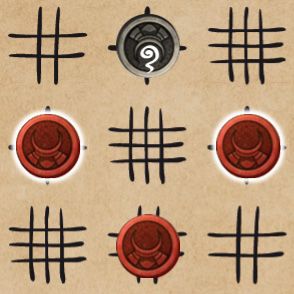
Mana HD is one of those. Created by French designer Claude Leroy, it’s a capture-your-opponent's-pieces game with a complexity somewhere between Checkers and Chess.
I digress. In short, the goal of the game is to capture your opponent’s daimyo while preventing the same.
Both players get to place their pieces within the closest two rows, but the red player always goes first and gets to rotate the board as seen fit. Whether this really provides any tactical advantage is up for debate, but there is a vague difference in the distribution of the game's three squares.
These squares form the crux of what makes the game unique. Instead of all pieces behaving the same way, as in checkers, or each uniquely, as in chess, the way your pieces move depends on two outside factors. The first is the space they rest on. Each square has anywhere from one to three hatch-marks on it. These marks equate to the number of spaces that piece can move — in a horizontal or vertical direction, never diagonally or passing over the same space twice.
While enticing your opponent into making certain moves is a mainstay of these sorts of games, the ability to actually decide which pieces are at the other player's disposal adds a layer of strategy that's novel and fun.
The presentation itself suits the elegant nature of the game, with graphics and sounds that are simple but beautifully evocative. The whole game hits those sort of notes. In a way, it’s much like the iPad itself.
Tuesday, January 25, 2011
Nom Nom Nom!
TURTLE TUESDAY

If there’s one website you must visit, it has to be this one.
TurtlesEatingThings.com doesn’t update often — the backlog isn't very extensive either — but it’s worth every chelonian chomp while it lasts.
If there’s one website you must visit, it has to be this one.
TurtlesEatingThings.com doesn’t update often — the backlog isn't very extensive either — but it’s worth every chelonian chomp while it lasts.
Friday, January 21, 2011
Thinking Inside the Box
The role-playing game has changed a lot in the past decades. It’s had its waxes and wanes in popularity, its trends in game design, and more than a few really funny looking dice along the way. But if you were to look at the industry from the outside — as someone who barely knew what an RPG was, much less concerned with the evolution of rules and design — one of the single most obvious changes is the abandonment of the boxed game.
That’s not to say there aren’t boxed games anymore. Wizards of the Coast’s new homage to the iconic Red Box can attest to that much. Nor am I saying that heavy hardbound tomes weren’t around ages ago, what with Gary Gygax’s approach for the original Advanced Dungeons & Dragons. But at the same time, game makers’ expectation of who their gamers are has drastically changed. A game's largest body of fans are the same grognards that have been buying RPGs for decades, a group that has little need for yet another set of dice.
It’s an expectation that makes sense. It doesn’t hurt that RPG fans host a disproportionately large gathering of bibliophiles that appreciate the beauty in a well-designed book. Abandoning the box allows a greater attention to creating such things and trims the fat out of a gaming collection.
Yet there just is something downright magical about a box. It’s more than a vessel for carrying contents; it’s a promise of the unknown. Beneath its cardboard exterior lay all the materials you need to embark on countless adventures — and probably a few things you don’t. But even if the back features a itemized list of every last punch-out token that hides inside, there’s still some glorious sense of surprise when you lift the lid off for the first time.
Boxes are inclusive. Modern rulebooks tend to be the domain of the Game Master, or a requisite purchase for all Players to invest in and make use of to create the awesomest hero. But when you whip out the box, there’s everything everyone needs. Hand over the introductory rulebook, pass out the character sheets! It makes trying a new RPG as easy as popping open Monopoly.
I think that feeling of open invitation is a grand factor in why board games are doing so well now. Even if there’s a high price sticker stuck to the front, there’s comfort in the idea you can just buy just that one thing and be ready to roll right out of the box. It doesn’t make the assumption you’ve played an RPG before, or that you have fellow geeks to explain it to you. It’s a gate all by itself, with a view of the world beyond and a set of keys hung neatly to its side, waiting for you and whoever else you want to bring along to unlock it.
And I think that’s a mistake much of the RPG industry is making. Despite being an entirely social activity, RPGs have become more and more a private place. The gate has been replaced with iron doors and the activities beyond like a clandestine secret society, their charter an endless collection of rules, addendum, and errata. There are players out there who don’t even know they love RPGs — the expansive realm of freeform message board role-plays are proof enough of that. I think our little niche of the world could be a slightly bigger one if we didn’t always wave around 10 pound books and instead proffered a little promise, sealed away in a box.
Subscribe to:
Posts (Atom)